
Something Bigger Is Happening
The First Shift: Capability
Matt Shumer is right. Something big is happening.
The acceleration in AI capability is not incremental. It is structural. Tasks that once required teams now require prompts. Work that once demanded weeks of coordination now compresses into hours. Intelligence, at least in its procedural form, is becoming abundant.
That transformation will reshape labor.
But after participating in and observer dozens of AI workflows inside operating businesses, I see a second transition unfolding beneath it, one that receives far less attention.
AI is not only changing what humans do. It is changing who the customer of software is.
The Architectural Transition
For decades, software was built primarily for humans. We clicked buttons, reviewed outputs, corrected mistakes, and absorbed edge cases. Even in distributed systems, a human usually remained somewhere in the loop.
Now we are entering a different architectural pattern.
Software is increasingly calling other software.
My business partner and co-founder, Elia Freedman, recently wrote a thoughtful piece on this shift titled Software-in-the-Middle: When Software Becomes the Customer. His argument is simple but profound: we are moving from human-in-the-middle systems to software-to-software systems, where the primary consumer of an API will be another system.
That shift carries deeper implications than most debates about job displacement.
Advisory vs. Operational
For the last several years, most AI has operated in advisory mode. It drafts documents, analyzes data, and suggests actions while humans retain final authority. In that environment, approximation is tolerable. A human can correct nuance or override a questionable result.
But as AI moves from advising to executing, the tolerance for approximation disappears.
When model output sets a price, initiates a payment, files a regulatory document, adjusts inventory, or influences a clinical workflow, the system is no longer assisting. It is acting. And once software acts on behalf of an organization, it becomes part of the organization’s operational substrate.
This is where friction consistently emerges in real implementations.
AI can absorb large portions of cognitive workflow with remarkable competence. The constraint rarely appears in drafting or summarization. It appears at the boundary where output must be stable across time, traceable across systems, and defensible under scrutiny.
That boundary is not about creativity versus automation. It is about governance.
When Software Becomes the Customer
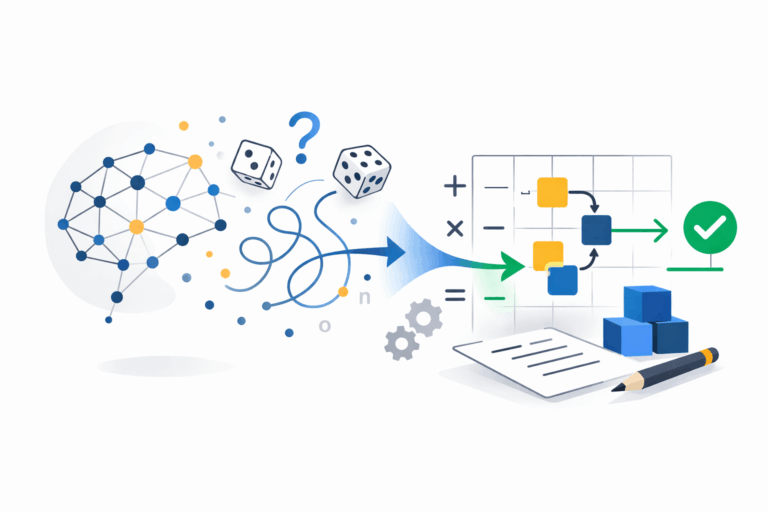
In a software-to-software environment, outputs are not read by humans first. They are consumed by other systems. Those systems assume determinism. They assume consistency under identical conditions. They assume that logic can be versioned and replayed.
Much of today’s AI-driven logic was not designed for that environment. It lives in spreadsheets, scattered code paths, loosely versioned repositories, and model checkpoints that evolve over time. These patterns function when humans provide the safety layer. They become fragile when execution is automated.
This is the infrastructure moment.
When software becomes the customer, contracts matter. Interfaces matter. Guarantees matter. Not as abstract principles, but as operational necessities. Reproducibility, versioning, and traceability become preconditions for scale.
The Emerging Constraint
The current conversation about AI focuses heavily on model capability: how far reasoning will extend and which professions will change. Those questions are valid. But as intelligence becomes cheaper and more capable, the bottleneck shifts.
The new constraint is governed execution inside a software-in-the-middle world.
As decision logic is externalized into automated systems, it must behave like infrastructure. It must preserve historical states. It must integrate predictably across quoting systems, billing systems, analytics pipelines, and compliance workflows. It must survive audits, disputes, and unexpected scale.
This does not contradict the thesis that AI will transform screen-based work. It is a consequence of it.
If AI absorbs a substantial portion of mechanical cognitive labor, then increasingly the remaining interactions are not human-to-software. They are software-to-software. And software does not tolerate approximation the way humans do.
The Deeper Shift
Intelligence is becoming abundant.
But abundance exposes a different scarcity: execution that can be trusted at scale.
The organizations that adapt most effectively will not only deploy more capable models. They will design systems in which automated decisions are stable, versioned, and accountable. They will recognize that as software becomes the customer, execution itself must be engineered with the same rigor we once reserved for data storage and financial transactions.
Something big is happening.
But beneath the explosion of capability is a quieter architectural shift.
We are moving from humans operating software to software operating software.
And when that happens, intelligence is only the beginning. Execution becomes the real engineering problem.
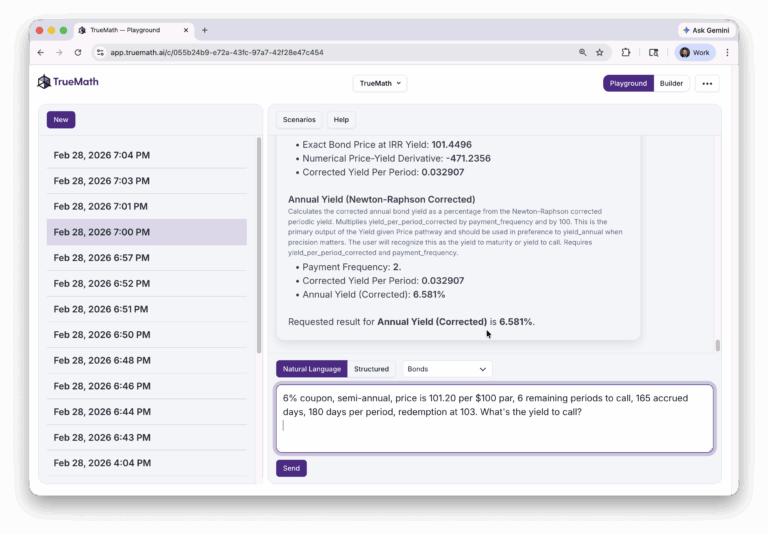
At TrueMath, this is the problem we are building toward. As AI moves from advisory to operational, the mathematical and logical computations at the core of automated decisions must be deterministic, verifiable, and reproducible. Not eventually. Now. The infrastructure moment Shumer describes is already producing the architectural constraints we anticipated. We are building the execution layer that governed software-to-software systems will require.
Reach out: bill.kelly@truemath.ai
Learn more: truemath.ai
Sign up for early access: https://app.truemath.ai/signup