Claude in Excel Is a Smart Start. Here’s the Next Step.
Excel has long been the gold standard for business math. It’s shareable, auditable, and incredibly flexible. A platform that has powered everything from start-up pro formas to billion-dollar valuations.
So when Anthropic announced that Claude was coming to Excel, it felt like a natural pairing. Claude’s conversational intelligence inside a spreadsheet environment? That could be useful. And in many ways, it is.
But it also reveals the limits of today’s AI integrations and the opportunity ahead for truly reliable math in AI workflows.
What Claude in Excel Gets Right
Embedding Claude into Excel offers a lightweight assistant that can:
- Explain confusing formulas
- Answer questions about spreadsheet content
- Debug issues and trace dependencies
- Help build or modify models without breaking the sheet
It’s the kind of intelligent assistant users have been craving, especially for large or inherited workbooks. Claude doesn’t just sit there. It reads, interprets, and communicates about the spreadsheet’s logic in plain language.
While Claude doesn’t enforce correctness or guarantee results, it does a surprisingly good job of interpreting spreadsheet logic and offering useful suggestions.
That’s genuinely helpful.
But Here’s the Catch
For all its promise, Claude doesn’t actually change the spreadsheet.
After Claude helps you, you still have an Excel sheet:
- One-off logic embedded in cells
- Error-prone formulas and fragile references
- No structured record of what changed or why
- No reusable logic across files, users, or workflows
And here’s the deeper issue. LLMs like Claude, ChatGPT, and Gemini are all still prone to hallucinations. They may explain a formula that doesn’t do what they say, or suggest logic that looks plausible but is subtly wrong. There is no way to audit those outputs, either in the chat interface or in the spreadsheet itself.
Claude doesn’t validate the math. It doesn’t enforce logic integrity. It doesn’t store assumptions or create reusable, versioned components. It’s still Excel as you know it, only now with a friendly AI explaining what’s (probably) happening.
This isn’t a knock on Claude. It’s just the limit of LLMs inside legacy tools.
Where the Real Opportunity Lies
The future of AI workflows isn’t just faster formulas. It’s dynamic, auditable, intelligent systems that adapt in real time and stand up to scrutiny. That future needs more than Excel with a chatbot.
To get there, we need to reimagine how calculations happen inside AI workflows and do so with:
- Deterministic math (no guessing)
- Audit trails (what was used, when, and why)
- Custom business logic (stored, versioned, governed)
- Dynamic recalculation (graph-based, dependency-aware)
- Explainability (what paths were taken and which were skipped)
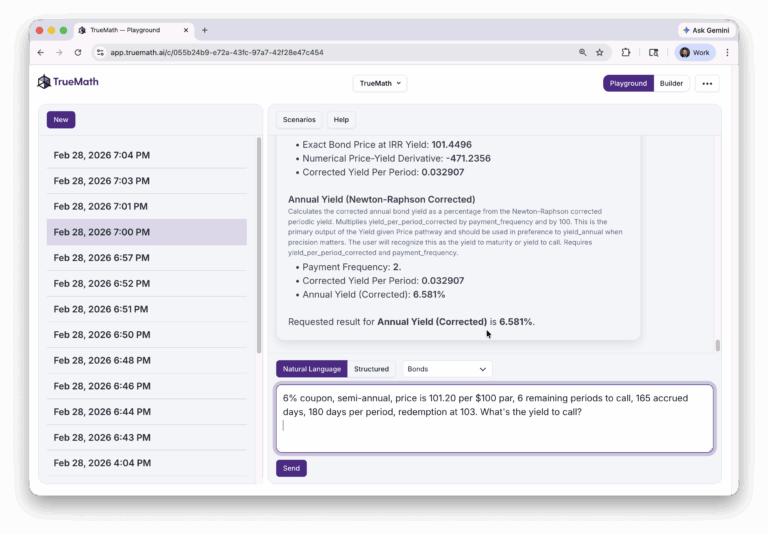
That is what TrueMath is built to do.
This isn’t an idea we came up with last quarter. Elia Freedman, our co-founder and CTO, has spent the last 30 years building calculator infrastructure for real business users. Over 30 million people have used his software in finance, real estate, health care, and beyond. He knows how much math matters, and how easily it breaks when it’s treated as a one-off.
Now we’re combining that experience with the power of LLMs. Let the language models handle interpretation. Let TrueMath handle the math.
TrueMath Complements, Not Replaces, Spreadsheets
We are not out to replace Excel. In fact, we believe TrueMath and spreadsheets are natural allies.
Here is how they will work together:
- Use Excel as the UI and data scaffold
- Use TrueMath as the computation engine, managing logic, defaults, versioning, and traceability
- Ingest spreadsheets as structured input
- Output structured results, with full audit, back into Excel
- Eventually, make TrueMath Activities callable within spreadsheet environments just like formulas, but with built-in validation and governance
We’ve already started. TrueMath is being piloted in early-stage integrations for banking infrastructure, AI assistants for real estate underwriting, and even custom AWS pricing calculators for finance teams. These are the kinds of workflows where accuracy, transparency, and explainability are not optional.
That future is on our roadmap, and it’s underway. But to scale it, we’re raising our seed round now so we can build the engineering team to deliver this vision.
Final Thought
Claude in Excel is a great step forward. It proves people want help making sense of their calculations.
But when the stakes are high, in finance, real estate, engineering, or compliance, “close enough” is not good enough.
You need math you can trust.
That’s TrueMath.
Reach out: bill.kelly@truemath.ai
Learn more: truemath.ai
Sign up for early access: https://app.truemath.ai/signup